How AI Background Removers Work: The Technology Explained
Automatic background removal feels like magic. Discover the machine learning architectures, semantic segmentation neural networks, and alpha-matting refinement layers that make it possible.
The Evolution of Image Segmentation
For decades, extracting a subject from a photograph required hours of manual labor. Graphic designers had to zoom in to the pixel level, carefully tracing edges with the Pen Tool or tweaking selection parameters in Photoshop.
Today, thanks to advancements in computer vision and artificial intelligence, you can use a remove background online tool to isolate a subject in seconds. This transformation is driven by neural networks trained to analyze pixels and identify visual objects.
This guide explores the technology behind AI-driven background removers, explaining semantic segmentation, trimap generation, and edge-matting networks.
Semantic Segmentation and Neural Network Architectures
At the core of an AI background remover is a neural network designed for semantic segmentation. Unlike simple classification (which identifies what is in an image), segmentation classifies every pixel in the frame as either foreground (the subject) or background.
Key architectures used in this process include:
1. Convolutional Neural Networks (CNNs)
CNNs process images by scanning them with mathematical filters, extracting features like edges, textures, colors, and eventually complex shapes (like faces, clothing, or products).
2. U-Net Architecture
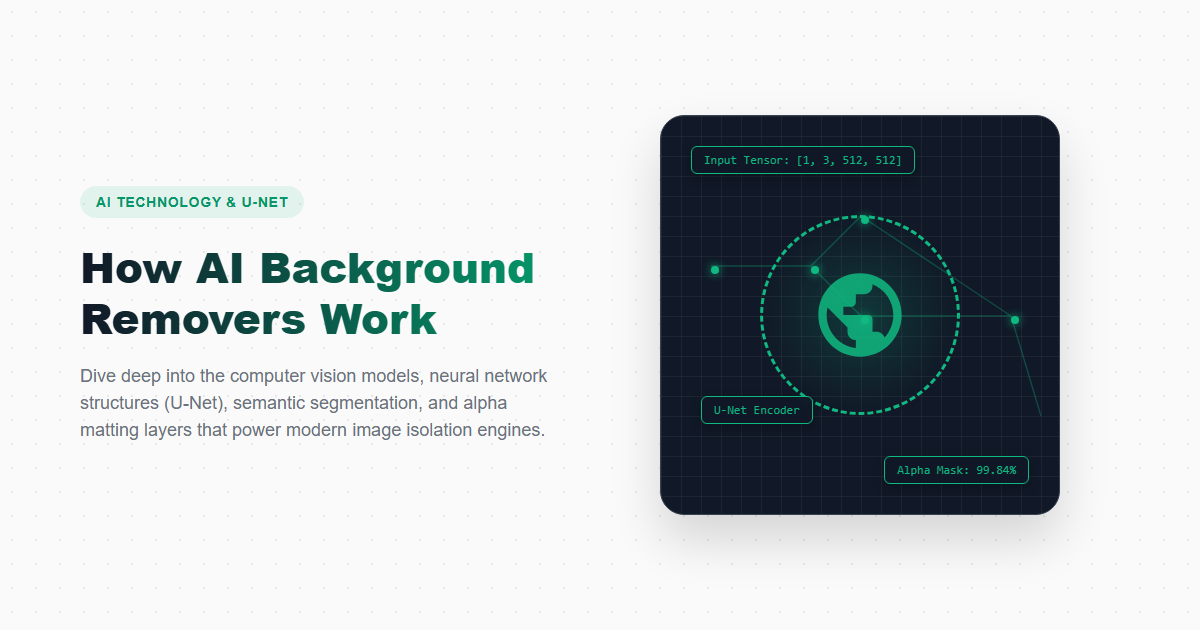
U-Net is a convolutional network architecture shaped like a "U." The first half (the encoder) compresses the image to capture context, while the second half (the decoder) restores spatial resolution to output a precise pixel mask.
3. Trimap Generation & Alpha Matting
To refine complex edges like hair or fur, the AI generates a "trimap" that divides the image into three regions: definite foreground, definite background, and an unknown transition zone. A matting network then evaluates the transition zone to predict the exact alpha opacity of each pixel.
The AI Background Removal Pipeline
Preprocessing
The uploaded image is resized and normalized to match the input specifications of the neural network model.
Feature Extraction and Segmentation
The network processes the image, identifying the primary subject and generating a coarse binary mask.
Edge Matting Refinement
The matting network refines the borders of the mask, analyzing fine details like hair strands or clothing fibers to create a soft, natural transition.
Alpha Channel Application
The refined mask is applied as an alpha channel, setting all background pixels to transparent, and the image is exported as a high-quality transparent PNG.
AI Segmentation vs. Manual Outlining
| Feature | AI Background Remover | Manual Pen Tool (Photoshop) |
|---|---|---|
| Processing Speed | Fast (2 - 5 seconds) | Slow (10 - 30 minutes) |
| Skill Level Required | None (One-Click) | High (Professional training) |
| Complexity Handling (Hair/Fur) | Very Good (utilizes edge-matting networks) | Excellent (with manual refinement) |
| Batch Processing | Yes (can process multiple images) | No (requires manual tracing per file) |
Technology Advantages
- Processes images in seconds, improving design workflows.
- Handles complex outlines (like hair, fur, and tree branches) automatically.
- Generates clean alpha masks for transparent overlays.
- Enables batch processing for large collections of product photos.
Current Challenges
- Can struggle with low-contrast edges where the subject matches the background.
- Requires significant computing power, often needing specialized cloud servers.
- May leave artifacts in busy backgrounds that require manual cleaning.
Frequently Asked Questions
What is the difference between semantic and instance segmentation?
Semantic segmentation groups all pixels of a certain class (e.g., all humans) into a single mask. Instance segmentation distinguishes between individual objects of the same class (e.g., separating individual humans in a crowd).
Why does AI struggle with hair edges?
Hair is made of very thin strands that mix with background colors. Resolving these transitions requires calculating partial opacity, which is computationally complex for neural networks.
Can I manually adjust AI-generated masks?
Yes. Most online background removers feature a brush editor that allows you to manually erase or restore specific regions of the mask.
Are my uploaded photos stored on your servers?
No, user privacy is important to us. Uploaded files are processed in secure memory and automatically deleted from our servers shortly after processing.
Do background removers support high-resolution photos?
Yes. Our AI background remover supports processing high-definition files up to 10MB, preserving the original resolution of the cutout subject.
Isolate Your Subjects Instantly with AI
Try our fast, browser-based AI background remover today. Upload your images and get clean transparent PNG cutouts in seconds.